The 5 Developmental Milestones
The 5 Developmental Milestones Your 2, 4 Year Old Should Be Hitting, And How Performing Arts Supports Every One
Every parent knows the milestone charts. The ones on the back of the maternal health pamphlets, the ones in the apps, the ones your well-meaning mother-in-law references at family dinners. And while no chart can capture the full richness of an individual child's development, milestones do give us useful signposts for what to watch for, and what to nurture.
What's less well known is how powerfully a performing arts environment supports children in reaching these milestones. Not as a shortcut or a guarantee, but as one of the richest developmental contexts available to a young child.
Here are five milestones that matter in the 2, 4 year age range, and what happens in a well-designed performing arts class that directly supports each one.
Milestone 1: Following Two-Step Instructions
By around age 3, most children are developing the ability to hear, process, and act on two-part instructions, "pick up your shoes and put them by the door," for example. This is a significant cognitive milestone that requires working memory, attention, and sequencing ability.
In a performing arts class, two-step instruction-following is woven into every activity. "Jump to the middle and then freeze." "Spin around and sit down." "Find a partner and hold their hand." Week after week, children practise this skill in a context that is engaging and low-stakes, so that by the time they encounter it in a kindy classroom, it feels familiar and manageable.
Milestone 2: Parallel and Cooperative Play
Between ages 2 and 4, children move through stages of social play, from playing alongside others (parallel play) to beginning to play cooperatively, with shared goals and negotiation. This progression is foundational to every friendship and every classroom dynamic they will ever experience.
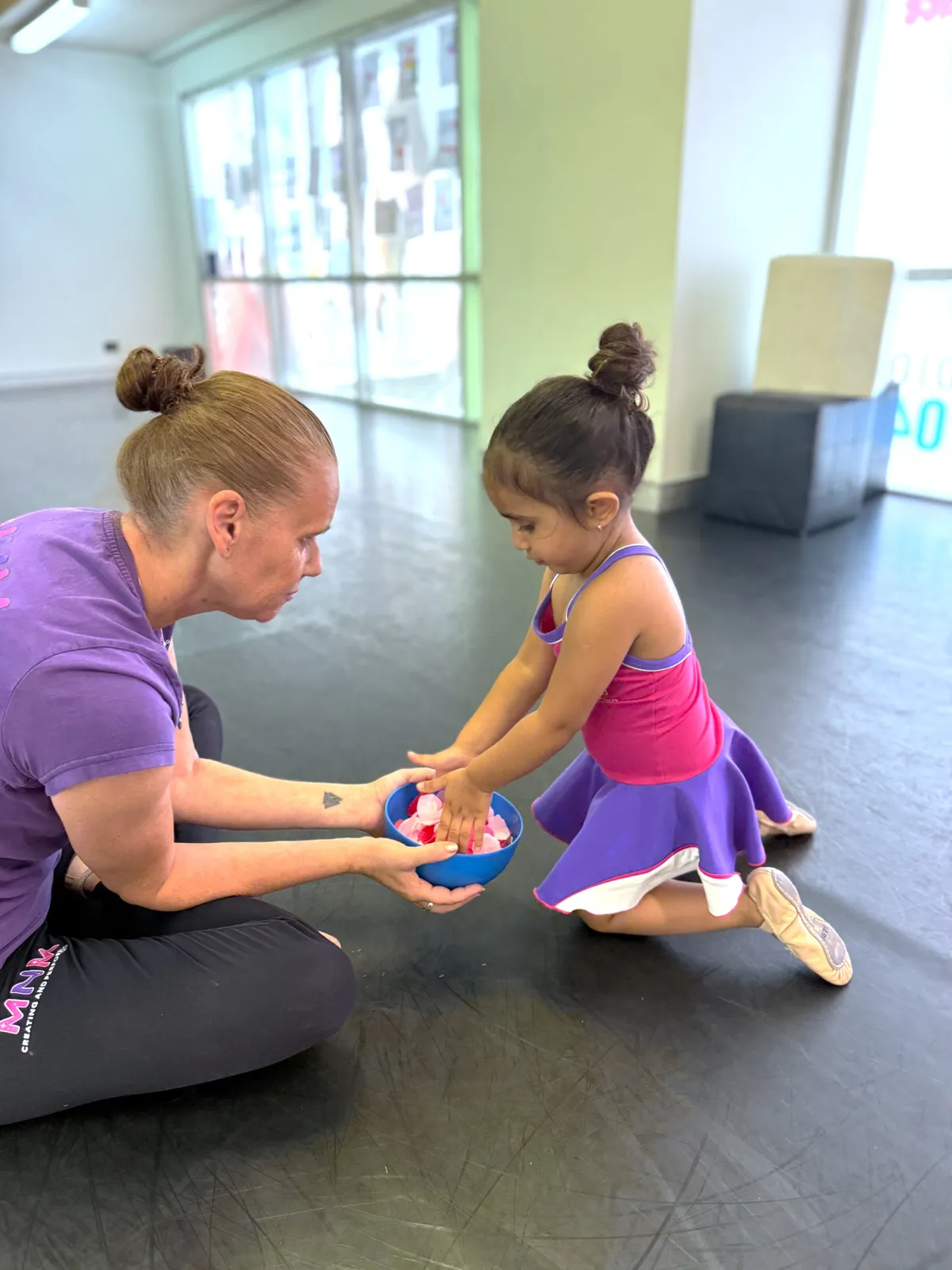
A performing arts class is a masterclass in the mechanics of cooperative play. Children share space, take turns, mirror each other's movements, and work toward a shared creative outcome. The structure of the class guides this progression gently, children who arrive only able to play alongside others often leave the term able to collaborate in small groups.
Milestone 3: Emotional Identification and Expression
The ability to name and express emotions, "I feel angry," "I feel excited," "I feel sad", is a critical milestone in early childhood. Children who develop this vocabulary earlier are significantly better equipped to manage their own behaviour, communicate their needs, and empathise with others.
Performing arts is one of the most natural emotional vocabularies that exists. When children explore characters, experiment with movement that expresses different feelings, or respond physically to music with different moods, they are building emotional literacy in their bodies and their language simultaneously. "What does happy look like in your body?" is a question that a performing arts class asks all the time.
Milestone 4: Gross Motor Coordination and Body Awareness
Between 2 and 4, children are developing rapidly in their physical capabilities, running, jumping, balancing, throwing, climbing. But alongside these broad physical skills, they are also developing something more subtle: body awareness, or the understanding of where their body is in space and how to control it with intention.
This proprioceptive development is directly and deliberately targeted in movement-based performing arts classes. Every exercise that asks a child to move one part of their body while keeping another still, to match the shape of a teacher or a peer, or to travel through space without bumping into others is building this awareness. It is the foundation not just for physical confidence, but for the fine motor skills that will support writing.
Milestone 5: Attention and Persistence
The ability to sustain attention on a task, and to persist when something is difficult, is one of the strongest predictors of school success. And it is, frankly, one of the hardest things to develop in a toddler or preschooler whose attention naturally flits and whose tolerance for frustration is still limited.
A well-structured performing arts class builds attention span gradually and purposefully. The class moves through different types of activities, high-energy and calm, group and individual, familiar and new, in a rhythm that stretches attention without exceeding it. Over a term, the attention a child can sustain grows measurably. This is not an accident. It is the design.
What This Means for Your Family
At MNM Creating and Performing, we think about milestones the way educators do, not as a checklist to tick, but as a map of where each child is and where they're heading. Our classes are designed to meet children across the full range of the 2, 4 developmental spectrum, and our teachers are trained to notice, celebrate, and gently extend each child's individual progress.
Your child does not need to be "on track" to join us. They just need to be themselves.
See our developmental approach in action. Book a free trial class at MNM Creating and Performing, Baulkham Hills.